

The Memento Problem
Why today's AI has the same condition as Leonard Shelby.

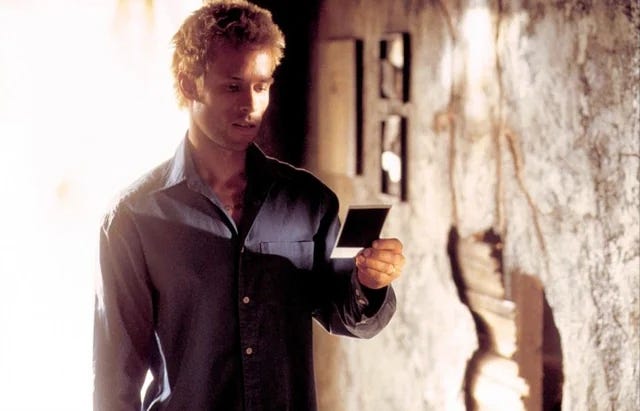
Leonard Shelby reads a photograph to remind himself who he is. Modern AI reads its prompt for the same reason. (Guy Pearce in Memento, 2000, dir. Christopher Nolan).
This is the first in a short series on continual learning: what it is, why it’s hard, and why it matters.
If you’ve seen Memento, you remember the opening. A Polaroid photo, a man holding it, shaking it, except the image is fading into the paper instead of developing. The film is running backward. It is our first clue that we’re about to spend two hours inside a mind that cannot build on what it just experienced.
Leonard Shelby, the protagonist, has anterograde amnesia. He can still remember his life before his injury, but he cannot form new long-term memories. Before long, the slate wipes. To survive, he leaves himself notes, Polaroids, and tattoos. The permanent facts, the ones he trusts enough to ink onto his body, are the things he has decided matter most. Everything else is written on paper that can be forged, lost, or slipped into his jacket by a stranger.
It’s a great movie. It is also a surprisingly accurate picture of how every mainstream AI system on your phone works right now.
Here is the thing most people don’t realize about large language models. They are trained once, then frozen. When you chat with one, it is not remembering your last conversation, unless something, or someone, has pasted that conversation back into the prompt. The model itself learns nothing from you. Not the joke you made yesterday, not the project you’ve been working on for three months, not the fact that your dog’s name is Sol. If the model seems to remember, it is because its “tattoos”, the system prompt, the chat history, a retrieved profile, have been handed back to it at the top of every new session.
These tattoos are impressive. Retrieval-augmented generation, long context windows, clever scratchpads. The industry has poured an enormous amount of work into helping a fundamentally amnesiac system get through the day. But, like Leonard’s tattoos, they are workarounds for the underlying problem, not a cure. And like Leonard, they can be manipulated. Anything in the context can be spoofed, poisoned, or quietly lost when the window rolls over.
You might wonder, reasonably, why we don’t just let the model keep learning. Why train once and then stop?
The answer has a dramatic name. It is called catastrophic forgetting.
When a neural network that already knows one thing is taught a new thing, it has an unfortunate tendency to overwrite what it knew before. Teach it French, and its English gets worse. Teach it yesterday’s news, and it loses the thread of last week. The very flexibility that lets models learn at all, the fact that every bit of knowledge is distributed across billions of weights, means new information tends to smear over old information. Researchers have known about this for decades. Kirkpatrick and colleagues gave it its most-cited modern treatment in 2017, and while we have gotten better at managing it, it has not gone away.
This is the heart of what researchers call the stability-plasticity dilemma. A system rigid enough to remember everything becomes too rigid to learn anything new. A system flexible enough to absorb every new fact will forget who it is by Tuesday. Biological brains, somehow, resolve this tension every day. Silicon ones, so far, mostly don’t.
Here is why this matters beyond the lab. The world does not stand still. Facts go stale. New products ship. Your preferences shift. Your relationships evolve.
A model that cannot continuously learn is, at best, a very articulate snapshot of the internet in some particular month, with a bag of tricks bolted on to fake the passage of time. It is Leonard reading his tattoos in the mirror, trying to convince himself he is moving forward.
There is a deeper question inside this one, and it is where the next article is going. When we say an AI system “learns”, what do we actually mean? Is learning the same thing as adding to a filing cabinet? Or is it closer to how a brain rewires itself as you live your life? Those two things look similar from the outside. They are not the same thing at all.
Next time, we’ll get into it.
Further reading
Malika Aubakirova, “Why We Need Continual Learning” — an accessible case for why this problem matters
Mengye Ren, “The Self Requires Learning” (2026) — a complementary take that also reaches for the Memento analogy, and pushes it further into the distinction between compression and retrieval
James Kirkpatrick et al., “Overcoming catastrophic forgetting in neural networks” (PNAS, 2017) — the canonical technical reference; the introduction alone is readable
Robert M. French, “Catastrophic forgetting in connectionist networks” (Trends in Cognitive Sciences, 1999) — the classic survey, still the best place to start on why this happens
Memento (2000), dir. Christopher Nolan
Update: the second piece in this series is now up. "AI Agents Don't Sleep. That's the Problem." It picks up where this one left off, on Leonard reading his tattoos, and asks what the brain is actually doing that today's AI agents cannot. Hassabis on memory, the hippocampus, and why bigger context windows are not the same as remembering.
https://apattichis.substack.com/p/ai-agents-dont-sleep-thats-the-problem